


What is a CMR consignment note?
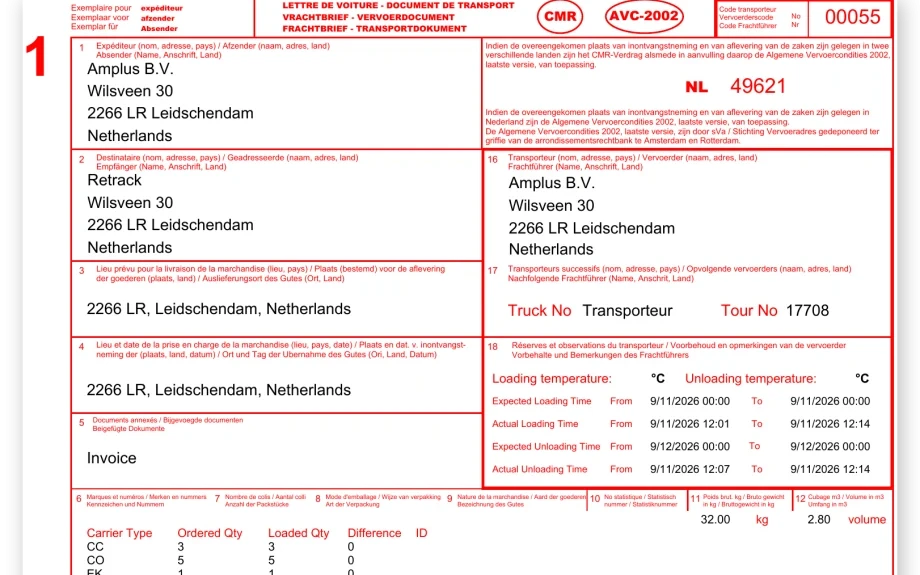
The CMR consignment note travels with an international road shipment. It proves what was agreed, what the sender handed over, and the condition it arrived in. Here is what it contains, who fills in what, and what changes when you make it digital.
The agreement on paper, not a title deed
CMR stands for Convention relative au contrat de transport international de Marchandises par Route, the convention signed in Geneva in 1956. It applies as soon as a road shipment crosses a border and at least one of the two countries is a party to it.
The note proves three things: that a contract of carriage exists, what the sender handed over, and the condition the consignee received it in. It is not a document of title. You cannot transfer ownership of goods by passing on the CMR, the way a bill of lading works in sea freight.
What the boxes contain
A CMR has 24 numbered boxes. When something is disputed afterwards, it is nearly always the same handful.
Boxes 1 to 4 record the parties and the route: sender, consignee, place of delivery, and the place and date of loading. Boxes 6 to 12 describe the shipment itself: number of packages, packaging, nature of the goods, gross weight and volume.
Box 13 carries the sender instructions, such as customs formalities or cash on delivery. Boxes 16 and 17 name the carrier and any successive carriers. Box 18 is the most important box on the document: this is where the carrier records reservations and remarks.
Boxes 22, 23 and 24 are the signatures of the sender, the carrier and the consignee in turn. Without that third signature you have no proof of delivery.
A completed note, box by box
The consignment note above is a real one, produced by Retrack TMS. Read it top to bottom and you can see where disputes come from.
Top left are the sender and consignee, with the carrier beside them. Below that, the place of delivery and the date of loading. Everyone fills this part in the same way.
The interesting block is the loading and unloading times, where expected sits next to actual: loaded at 12:01 against a window that opened at 12:00, unloaded at 12:07. Any later conversation about waiting time is a conversation about those two lines.
Under that is the equipment: carrier type, ordered, loaded, and the difference. CC 3 ordered and 3 loaded, CO 5 and 5, EK 1 and 1. On a paper form this is usually the box left empty, which is how it ends up as a separate spreadsheet.
At the foot are three signatures and the fields for loading and unloading problems. A note without that third signature is not proof of delivery, however neatly the rest is filled in.
Why box 18 decides arguments
If the carrier accepts the shipment without remark, the law assumes the goods and packaging were in good condition and the package count was correct. Anyone trying to prove otherwise later is starting from behind.
A reservation therefore has to be specific and written at the time. "Box 3 dented on the top" is usable. "Subject to inspection" is not: a general reservation without a reason carries no weight unless the sender accepted it.
It is also exactly why a photograph taken at loading or unloading is worth so much. A remark in box 18 with a matching photograph is hard to argue with.
Three copies, and the colours
The convention requires three originals, all signed by sender and carrier. The first goes to the sender, the second travels with the goods for the consignee, the third stays with the carrier.
In practice you often see four sheets in red, blue, green and black. Those colours are not in the convention; they are a printers convention, and the fourth sheet is for the carrier own records. Arranging the set differently breaks no rule, as long as the three originals exist.
AVC or CMR: which applies to your trip?
The difference is the border. If the shipment goes by road to another country and at least one of the two is a party to the CMR convention, CMR applies and you cannot contract out of it.
If the trip stays inside the Netherlands, the AVC conditions usually apply instead. Those are not statute but standard terms: they apply because the parties declare them applicable, and many customers do so by default.
The forms look similar in practice. The difference that matters is liability. CMR sets its own limit per kilogram and its own time bars; AVC handles that differently. So which regime applies decides what a damage claim eventually costs you.
That is why many Dutch consignment notes cite both: AVC for the domestic leg, CMR once the trip crosses a border. The note above shows exactly that, with AVC-2002 printed next to the CMR mark.
Consignment note or packing list?
They get confused, but they do different jobs. The consignment note records the contract of carriage between sender and carrier, and both sign it. It is about the transport.
The packing list belongs to the delivery to the customer and describes what is inside. It governs nothing about the carriage, and for the carrier it proves nothing.
Hence the practical rule: a signed packing list is not proof of delivery in the transport-law sense. If your customer says something was missing, box 18 of the consignment note is the document that matters, not the packing list.
When is it required?
For international road carriage between contracting countries the CMR convention is mandatory law: the parties cannot contract out of it. Note that a missing consignment note does not void the contract of carriage; what you lose is your evidence.
For domestic carriage within the Netherlands the AVC conditions usually apply instead of CMR, and many customers then require an AVC consignment note. Whether it is mandatory in your situation depends on what you agreed contractually. If in doubt have your own lawyer check it, rather than relying on a software vendor reading of the rules.
What changes when the note goes digital
The 2008 eCMR protocol gives an electronic consignment note the same legal weight as a paper one, between countries that have ratified it. The Netherlands, Belgium, Germany, Spain and France are among them.
What really changes is the pace. A paper CMR is only finished when it physically reaches your office: it rides in the cab, sits in a folder overnight, and arrives days after the delivery. Until then you cannot invoice, and you cannot show anything to a customer who disputes the drop.
Digitally, the document is captured where the delivery happens. Signature, timestamp and photograph attach to the trip immediately, and the data is in the back office straight away.
FAQ
Is a CMR consignment note legally required?
For international road carriage between contracting states the CMR convention applies by force of law. If the note is missing the contract of carriage still stands, but you lose the evidence of what was handed over and in what condition.
What is the difference between a consignment note and a packing list?
A consignment note records the contract of carriage between sender and carrier and is signed by both. A packing list belongs to the delivery to the customer and describes what is inside the shipment. Different purpose, different legal standing.
Who is responsible for filling it in?
The sender enters the shipment details and is answerable for their accuracy. The carrier checks at loading and records any reservations in box 18. The consignee signs on delivery.
Does a digital CMR carry the same weight as paper?
Between countries that have ratified the eCMR protocol, yes. Ratification is uneven, so on some lanes paper is still needed. A system that handles both lets you choose per trip without running two administrations.
What does a completed CMR look like?
The e-CMR page shows a real consignment note produced by Retrack TMS, with signatures, actual loading times and the equipment reconciliation on it.
See the e-CMR page